Weighted vest buying guide
Walks, bodyweight strength, runs and HIIT. Add safe, progressive load without hurting your joints or paying for more vest than you need.
We don’t test in a lab. We read the evidence and link every claim to its source.
Your load window
5–10%
of bodyweight to start
150 lb
Start at (5%)
7.5 lb
Top out near (10%)
15 lb
A vest whose lightest setting sits above your top number is out. Why this window: the evidence below.
01 / The job
Add safe, progressive load to the exercise you already do (walks, bodyweight strength, runs and HIIT) without hurting your joints or paying for a heavier vest than you need.
Light frame or small torso
A vest that can sit at 5-10% of a low bodyweight, in small steps.
Wants to progress for months
Adjustable load, a fit that does not bounce, room to grow.
Budget, adjustable
Cheapest way to add load in steps, up to about 20 lb.
Loaded walks only, lowest cost
A simple fixed-weight vest for walking, stairs and light conditioning.
02 / Dealbreakers
Six ways
to rule one out.
Each has a quick test you can do at home. Fail one, skip that vest.
01
Your load window
Work out 5% and 10% of your bodyweight first. A vest whose lightest setting is above the 10% number is out.
Test at home
Bodyweight x 0.05 and x 0.10. Example: 150 lb gives 7.5-15 lb. If the vest's lightest setting is above the top number, skip it.
3 sources
- “A good starting point is 5 to 10% of your body weight” news.umiamihealth.org
- “should not exceed more than 10% of your total body weight” nm.org
- “Regarding the loading weight, WRT showed a significant improvement when the load was ≤10% BM.” frontiersin.org
02
Health check before you buy
Current back, neck, shoulder, hip or knee pain, disc or spine problems, osteoporosis, pregnancy or balance problems: ask a clinician first.
Test at home
Ask yourself: any current pain in the back, neck, shoulder, hip or knee, or a diagnosed disc or spine problem? Yes: ask a doctor or physical therapist before buying. (Our own extra check, not from a source: stand on one leg for 10 seconds each side without grabbing anything. If you can't, ask first.)
3 sources
- “Some individuals should avoid weighted vests due to the potential for injury or exacerbation of existing conditions” news.umiamihealth.org
- “it's best to consult with your physician before trying a weighted vest” newsroom.clevelandclinic.org
- “out of concern that weighted vest use could exacerbate those conditions” aarp.org
03
It must not bounce
A vest that shifts or thumps during quick movement is out for squats, lunges and hops.
Test at home
Load it to your planned weight. Do 5 quick bodyweight squats and 5 small hops. If you see or feel it slide or thump, return it.
2 sources
- “Make sure the vest sits securely and does not bounce or ride up.” hyperwear.com
- “An ill-fitting vest may bounce around, creating an uncomfortable experience.” garagegymlab.com
04
You must be able to breathe fully
If you can't take a full deep breath, the vest is too tight or too heavy on the chest.
Test at home
Fasten at full load and inhale deeply. Ribs and belly should expand without the straps biting. Check again after 2 minutes of brisk walking.
2 sources
- “It should be snug and secure, but not so tight that you feel like you can't take a full, deep breath.” si.com
- “It should not restrict breathing or movement.” hyperwear.com
05
Lightest setting must fit your window
A fixed-weight vest can't be turned down, and some adjustable ranges start high.
Test at home
Find the vest's lightest setting on the product page. Compare with your 10% number from D1. Above it: skip.
2 sources
- “Soft fixed-weight vests are easier for walking, stairs, and beginner conditioning.” fitnessvolt.com
- “Weight Range: 20 to 40 lbs, depending on size” hyperwear.com
06
Check what is in the box
A plate carrier may arrive with no load at all.
Test at home
Search the product page for 'plates included' or 'sold separately' before ordering.
1 source
- “5LB Plate Pair” roguefitness.com
03 / What matters
Five things change the result.
Ranked. Everything else on the box is noise.
1
Smallest usable load and step size
At 5-10% of bodyweight a light user needs a light start and small steps. A vest that only goes in 5 lb jumps is coarse for them (our inference).
2 sources
- “allowed us to really fine-tune our setups” barbend.com
- “5LB Plate Pair” roguefitness.com
2
A fit that doesn't bounce
Load that moves under you is the main thing that turns a squat or lunge into a risk. Snug torso fit and even weight beat a bigger load.
2 sources
- “Look for a snug torso fit, even front-and-back weight distribution, and padding that does not dig into your neck.” fitnessvolt.com
- “Many weighted vests use bulky, concentrated weights that can shift during movement.” omorpho.com
3
Even weight distribution
Spread front and back keeps the load from tipping you forward or back.
1 source
- “Equal weight distribution is another aspect to look for.” rollingstone.com
4
Torso-based sizing
Fit follows the torso, not just bodyweight. Measure and match the brand's own chart.
2 sources
- “Sizes run small so size up when in doubt.” hyperwear.com
- “adjustable shoulder straps to set the proper length for your torso” omorpho.com
5
Care and materials
Sweat damages the vest over time. Plan to wipe and air-dry.
2 sources
- “DO NOT MACHINE WASH” support.decathlon.co.uk
- “perspiration, which is corrosive and can damage your equipment over time” support.decathlon.co.uk
04 / Ignore the noise
Myth. Busted.
A weighted vest will make you jump higher or perform better in your sport.
A 2025 review found no significant jump gain from wearable resistance. Trunk load at or under 10% of bodyweight helped the first 10 m of a sprint, and that is the only gain it supports. We found no study of vests on skaters or most other sports. A vest is an optional way to add load to walks, squats, lunges and step-ups.
2 sources
- “WRT did not significantly improve jumping ability.” frontiersin.org
- “WRT with trunk load and weights ≤10% of BM can enhance start acceleration (0–10 m) during linear sprinting.” frontiersin.org
Heavier is better.
Health systems say 5-10% of bodyweight. One expert allows 10-15% at the maximum. Heavier loads carry more injury risk.
3 sources
- “5 to 10% of your body weight” newsroom.clevelandclinic.org
- “can actually increase your risk for injury” newsroom.clevelandclinic.org
- “10% to 15% of their body weight at the maximum” healio.com
A vest on its own builds strength.
It only adds load to other exercise.
1 source
- “wearing a weighted vest alone won’t help build strength” scrippsnews.com
Weighted vests build bone density, so buy one.
Some evidence in postmenopausal women when combined with jumping. Not shown to beat ordinary lifting, and a 2025 trial found vests alone did not stop weight-loss bone loss. Not a reason to buy one on its own.
2 sources
- “I have not seen any definitive literature that shows it is more beneficial than resistance training or weight training” healio.com
- “wearing weighted vests alone did not prevent bone loss associated with weight loss” scrippsnews.com
A 'breathable' vest keeps you cool.
Nobody delivers a truly breathable vest. Don't pay extra for the word.
1 source
- “a truly breathable weighted vest is still more dream than reality” runnerclick.com
05 / Trade-offs
Every vest
costs you something.
Fixed-weight soft vest
You gain
Simple and cheap; fine for loaded walks.
Fixed-weight soft vest
You give up
Can't be turned up or down, so a wrong guess is permanent.
1 source
- “Soft fixed-weight vests are easier for walking, stairs, and beginner conditioning.” fitnessvolt.com
Adjustable small-step vest
You gain
Start at 5% and add a little at a time.
Adjustable small-step vest
You give up
Premium band; weights and sizes vary by brand.
1 source
- “allowed us to really fine-tune our setups” barbend.com
Plate carrier
You gain
Load as heavy as the plates you add.
Plate carrier
You give up
Plates are extra, steps are coarse, and the vest has its own weight.
2 sources
- “Plate carriers feel more stable for intense bodyweight workouts.” fitnessvolt.com
- “1.75LB (Medium)” roguefitness.com
Going to 10-15% of bodyweight
You gain
More load per rep (one expert's ceiling).
Going to 10-15% of bodyweight
You give up
More joint force and injury risk; benefit seen in a review at or under 10%.
2 sources
- “10% to 15% of their body weight at the maximum” healio.com
- “A weighted vest would add to compressive forces on the joints and overall impact on the body.” nike.com
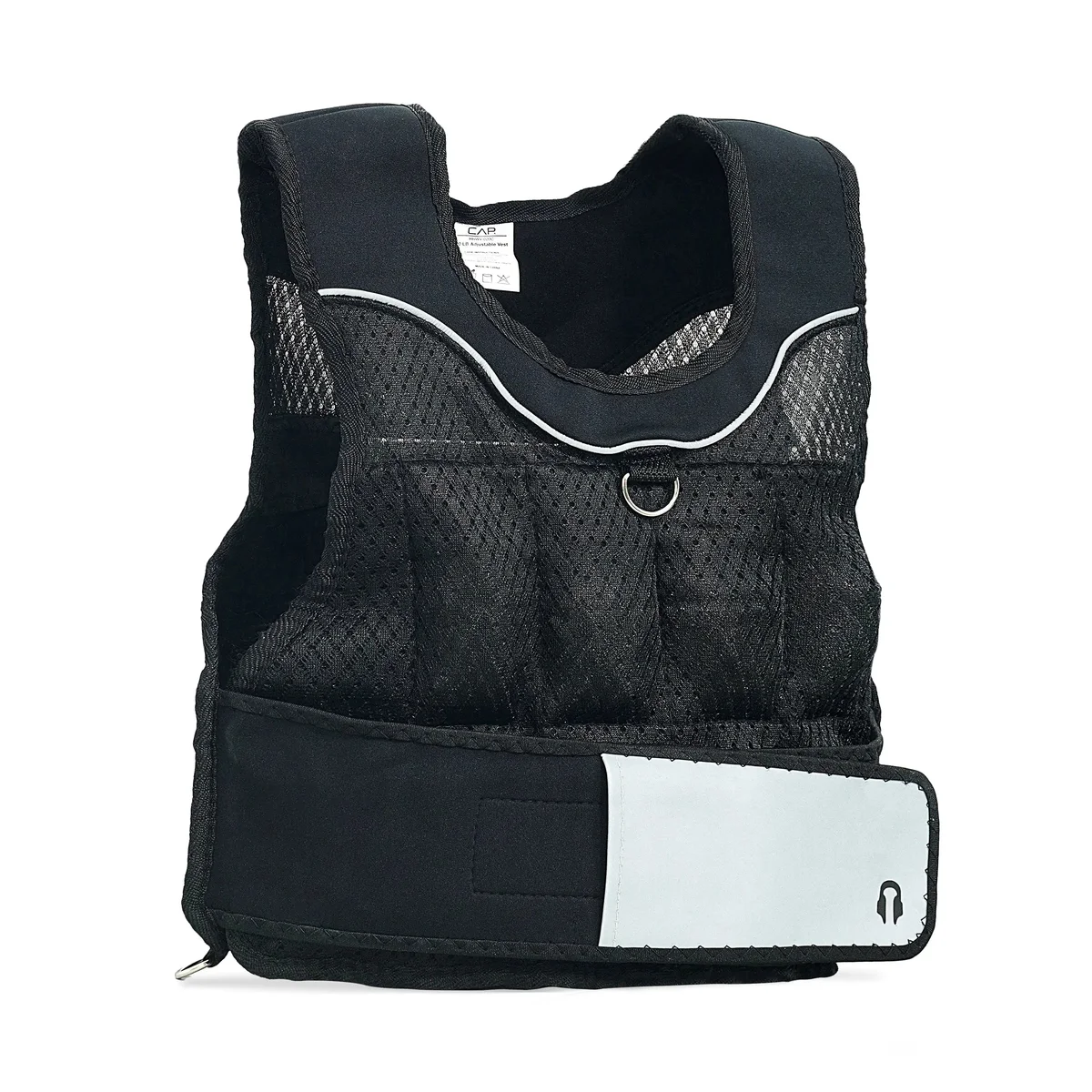
- Budget CAP Barbell 20 lb Adjustable Weighted Vest, Sunny Health & Fitness Fixed Weighted Vest (SF-WV02)
- Premium Hyperwear Hyper Vest FIT, Hyperwear Hyper Vest ELITE
06 / Decision path · Question 1
Which vest is right for you?
Before you choose: do the health check (D2).
Is 10% of your bodyweight under about 13 lb (roughly 130 lb or less)? Your main use: walks, strength circuits, or runs and HIIT.
07 / Picks
Four picks.
One is yours.
Budget adjustable, up to 20 lb
CAP Barbell 20 lb Adjustable Weighted Vest
Budget
Buy if You are over about 130 lb, want to add load in steps, and need to keep cost down.
Skip if Your 10% is under 10 lb, or you need a documented no-bounce fit.
Runner-up: Hyperwear Hyper Vest ELITE
See it on Amazon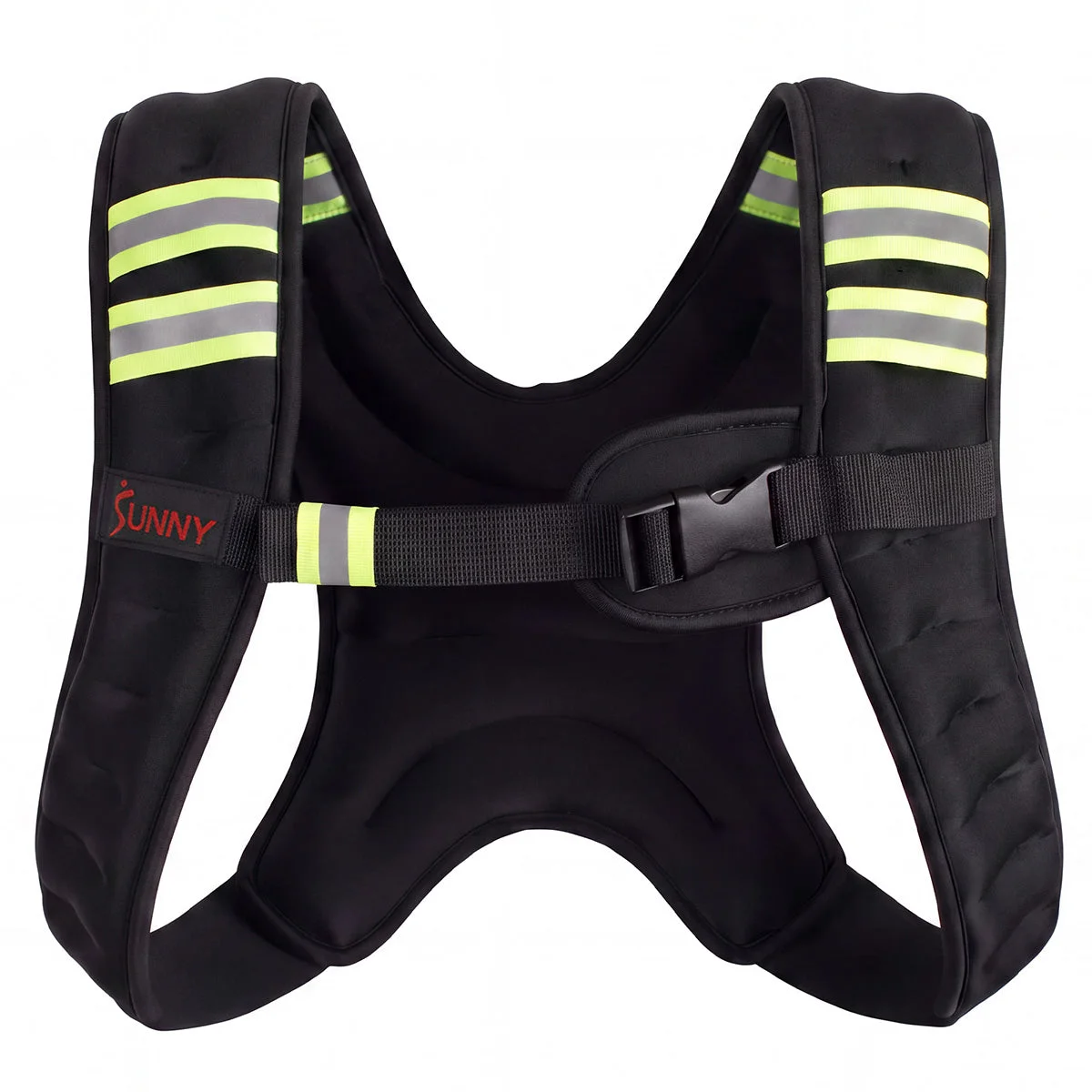
Simple fixed vest for loaded walks
Sunny Health & Fitness Fixed Weighted Vest (SF-WV02)
Budget
Buy if You only want loaded walks and stairs and you already know the weight you want.
Skip if You want to progress or use it for squats and lunges, or the weight you pick turns out wrong. It can't be changed.
Runner-up: CAP Barbell 20 lb Adjustable Weighted Vest
See it on Amazon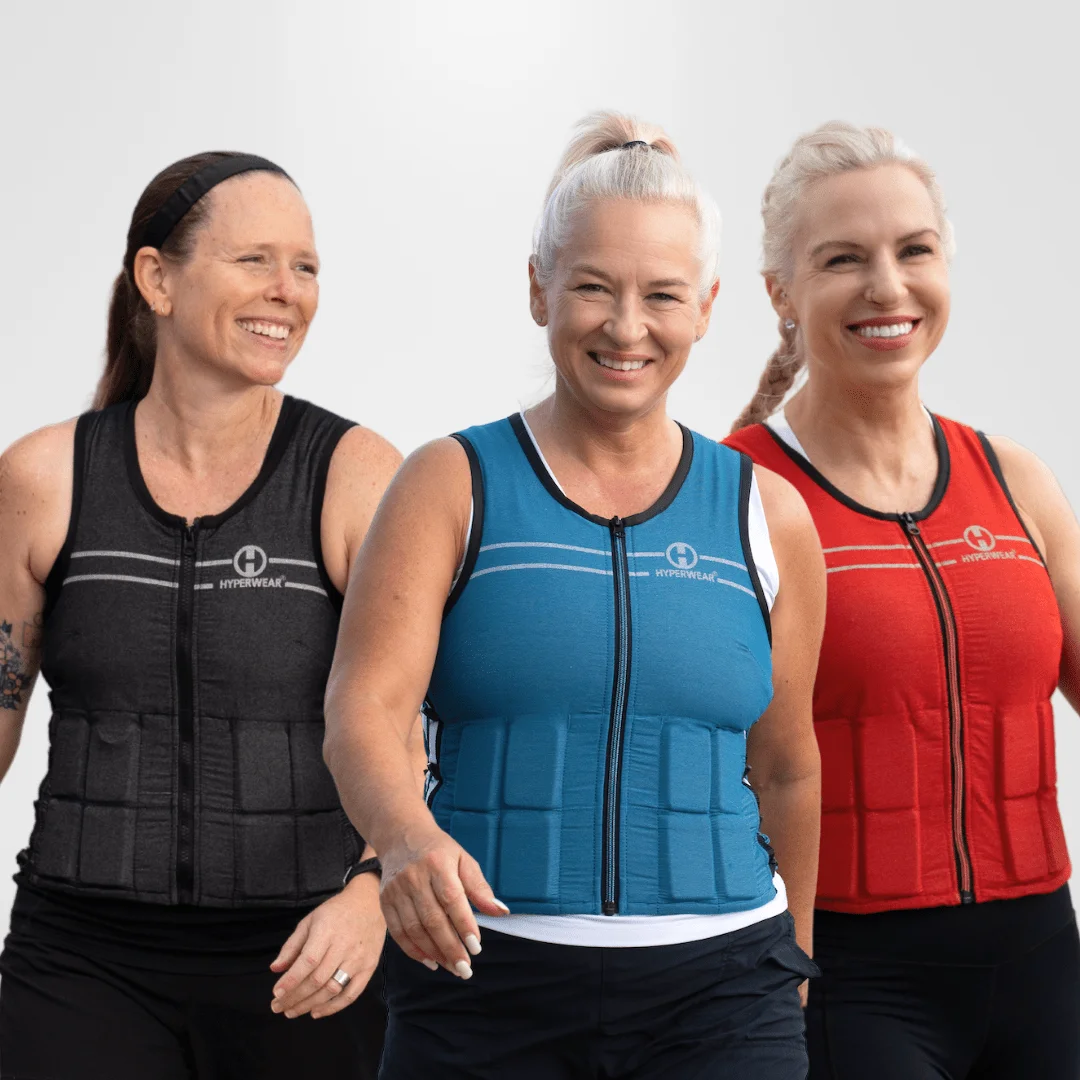
Best fit for a light frame or small torso
Hyperwear Hyper Vest FIT
Premium
Buy if 10% of your bodyweight is under about 10 lb, or you want a women's cut and ½ lb steps.
Skip if You will want more than 10 lb, or you want a heavier training load.
Runner-up: Hyperwear Hyper Vest ELITE
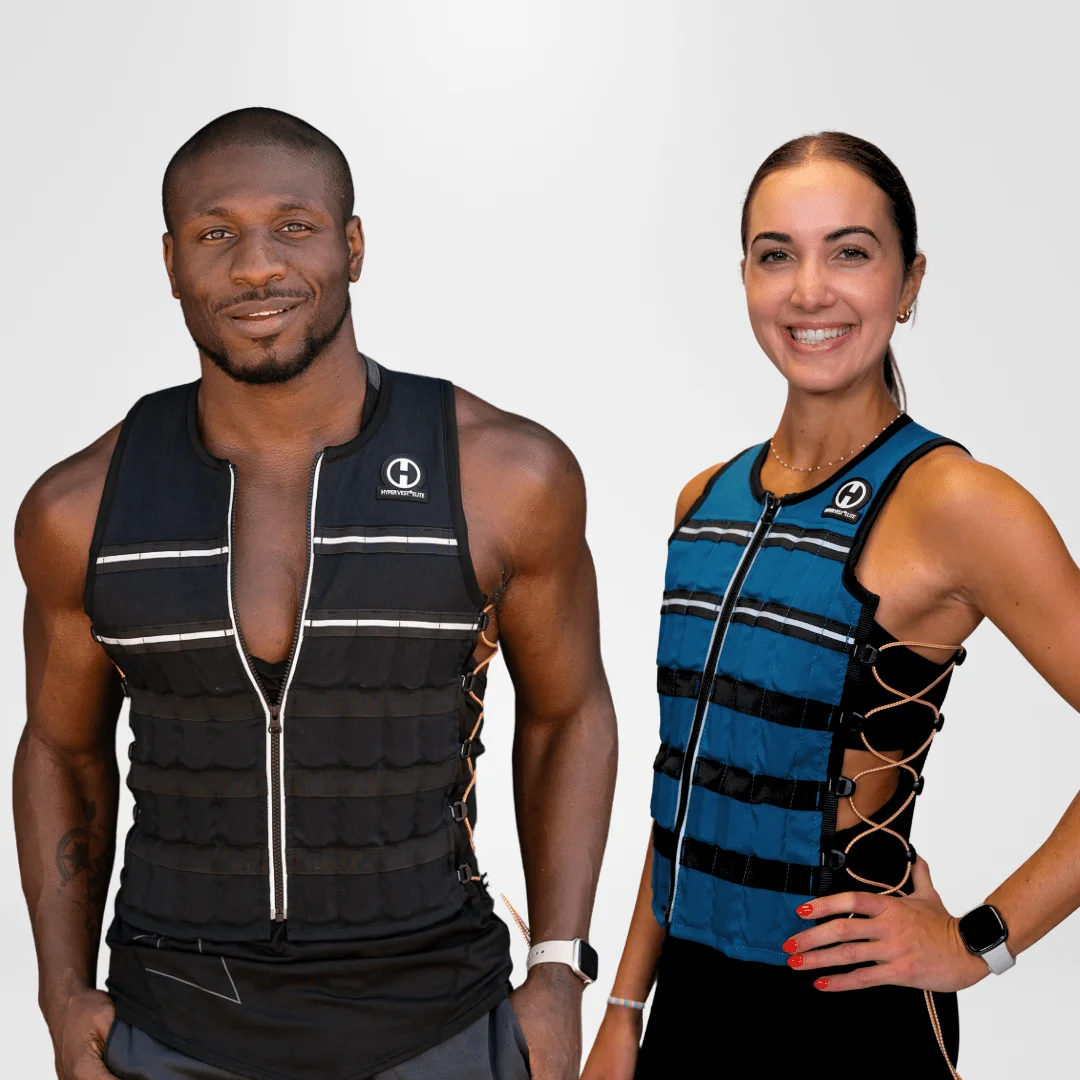
Best vest to grow into
Hyperwear Hyper Vest ELITE
Premium
Buy if You want an adjustable vest with a 10 lb start for walks, strength circuits or runs that stays put when you move.
Skip if 10% of your bodyweight is under 10 lb, or you want the lowest cost.
Runner-up: Hyperwear Hyper Vest FIT
As an Amazon Associate we earn from qualifying purchases made through links on this page. It doesn't change which product we recommend. How we make money
08 / Own it right
Start lighter than you think.
01
Start lighter than you think
1 source
- “start lighter than you think and build only after your movement looks and feels normal.” hyperwear.com
02
Change one thing at a time
1 source
- “increase only one variable at a time — weight, duration, or intensity.” hyperwear.com
03
Add load slowly, only when it feels easy
1 source
- “add load slowly, in small increments, and only once your current weight feels easy with clean form.” thebattlebunker.com
04
Start with walking, not running
1 source
- “Walking is significantly lower impact than running” nike.com
05
If the vest changes your gait or makes walking feel clumsy, don't add load
1 source
- “Do not increase load if the vest changes your gait or makes walking feel clumsy.” hyperwear.com
06
Treat vested jumps as optional and the highest-risk use
1 source
- “A weighted vest would add to compressive forces on the joints and overall impact on the body.” nike.com
07
Keep strength, flexibility and mobility work going
1 source
- “It's still essential to work on your strength, flexibility and mobility.” espanol.atlantichealth.org
08
For skill sports such as skating, keep the vest for off-ice training, not the skill itself: one reader comment on a skating-coach site calls it a bad idea and we found no governing body that recommends it
1 source
- “wearing a weighted vest during specific skill work is not a good idea, regardless of the sport.” icoachskating.com
09
Hand wash and air dry; never machine wash
1 source
- “Easy to hand wash with mild detergent and air dry.” hyperwear.com
Where sources disagree
- Load: sources say 5-10%, up to 10-15%, or 3%. We say start at 5%, 10% is the practical ceiling.
- Vested jumps: a maker lists plyometrics; PTs advise caution. We say keep jumps unweighted and treat vested jumps as optional.
- Bone density: overstated. Said once, in N4.
- Wearing a vest for skill sports such as skating: one reader comment only. We say we found no evidence for it, not that it is proven harmful.